
What We Ask of Wool
About the Journal section of our new website: Here, we intend to post musings, learnings, and stories from our time in the mill and working with local fibers. These pieces are meant to be an accompaniment to our activities in the mill, and the garments and products we produce. We always love to have conversations and appreciate any feedback about these stories, and ideas about what we should talk about next!
Here, we dive into superwash wool, minimally processed fiber, and the simple practice of caring for what we wear. Enjoy and thanks for reading!
A pair of wool socks that can move from the washing machine to the dryer without much thought may not seem remarkable. In our current day and age, it probably feels ordinary. Most of us have come to expect clothing that can withstand hot water, agitation, detergent, and heat – and emerge looking much the same as it did before.
What many don’t know is that wool does not naturally behave that way.
An untreated wool fiber is covered in microscopic scales. When those scales meet moisture, heat, and friction, they can open and catch against one another. The fibers draw closer together, creating the density and shrinkage we know as felting (a process we love dearly here at Aurora!).
Sometimes felting is intentional. It is how we make many of the sauna hats, vests, booties, and other finished woolens here at Aurora. But it is less welcome when a favorite sweater comes out of the wash several sizes smaller than it went in.
Superwash wool was developed to prevent that.
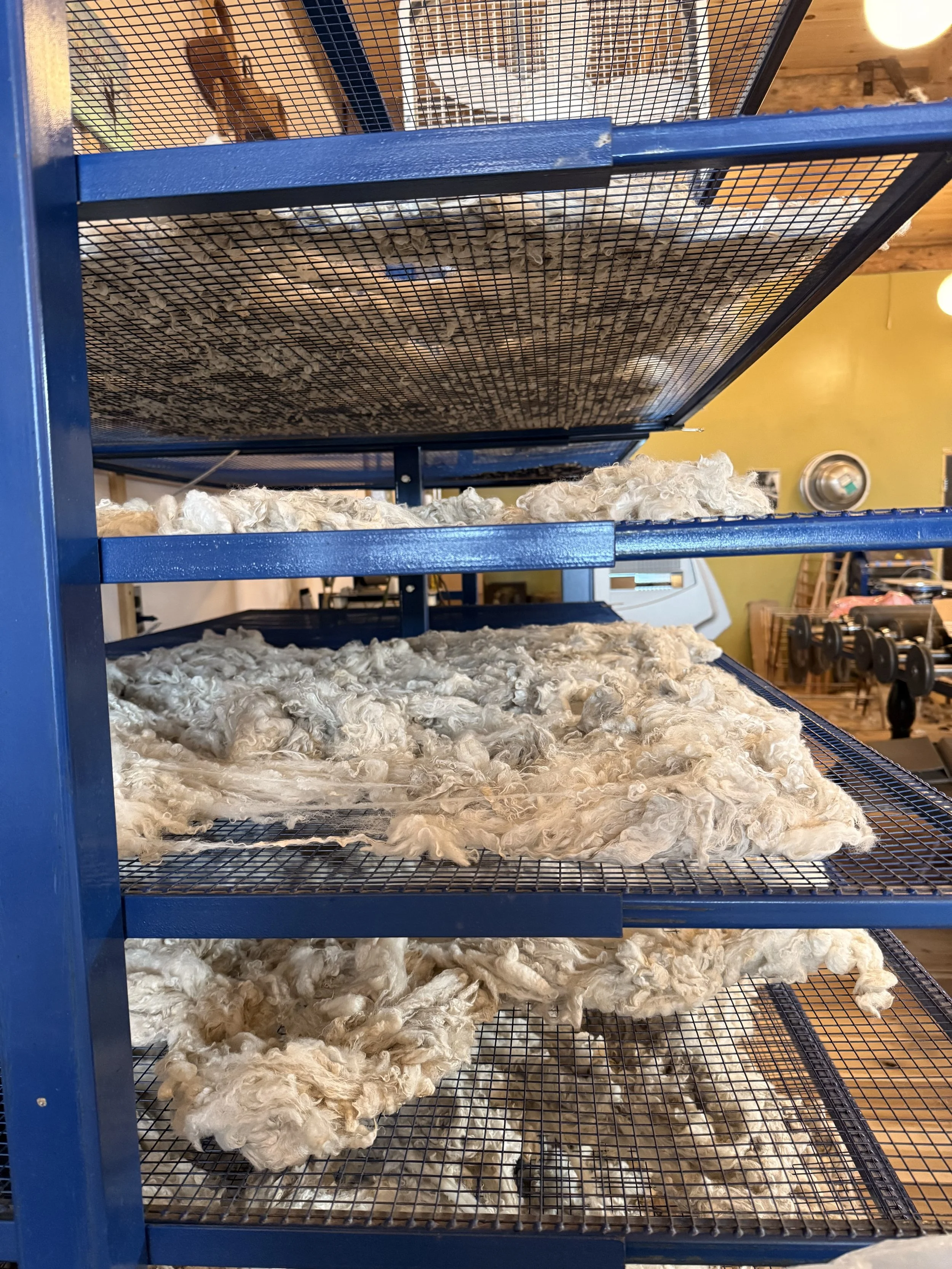
Wool drying after washing, a beginning step in our processing cadence.
What is superwash wool?
Superwash is an industry term for wool that has received a shrink-resistant treatment, allowing it to be washed by machine without excessive felting or distortion.
There is more than one way to make wool machine-washable. The most established industrial method modifies the scales on the surface of the fiber and applies a very thin polymer treatment that keeps those scales from locking together in the wash. Newer chlorine-free and lower-impact methods are also being developed and used.
The result is still wool, but wool that has been altered to better accommodate modern laundry habits.
Superwash wool is widely used in socks, base layers, children’s clothing, and everyday knitwear. It can be a genuinely useful choice. A parent washing a baby’s clothes, a person who cannot comfortably hand-wash a garment, or anyone relying on frequently washed wool layers may reasonably value that convenience.
This journal story is not about superwash wool being inherently bad. Rather, it is a story about what different forms of wool ask of us – and what they make possible.
An industrial solution
Shrink-resistant wool treatments require specialized equipment, carefully controlled chemistry, significant volumes of fiber, and systems for managing the water and byproducts that result. They belong to a scale of textile manufacturing very different from a small regional mill.
When Kristen began apprenticing at a fiber mill in Waitsfield, she was learning another way of working with wool: sorting and washing fleece, carding fiber, spinning yarn, and preparing it for whatever it would become next.
When that mill equipment eventually came to Dodge Farm, superwashing was never going to be one of the mill’s services. Aurora is not built for that scale or kind of processing. Instead, our work is focused on moving wool from the sheep’s back toward its next useful form while intervening as little as we reasonably can.
For the farmers and shepherds who bring their fiber to our mill, that may mean clean roving or finished yarn returned to the farm to be sold, knit, woven, or felted. For wool we raise or source ourselves, it may mean a garment made here in central Vermont, made to be worn by our friends, family, and enthusiastic local wool supporters.
In either case, the fiber remains recognizable. Its natural structure, variation, elasticity, and character are still present. That is what we mean by “minimally processed” here at Aurora.
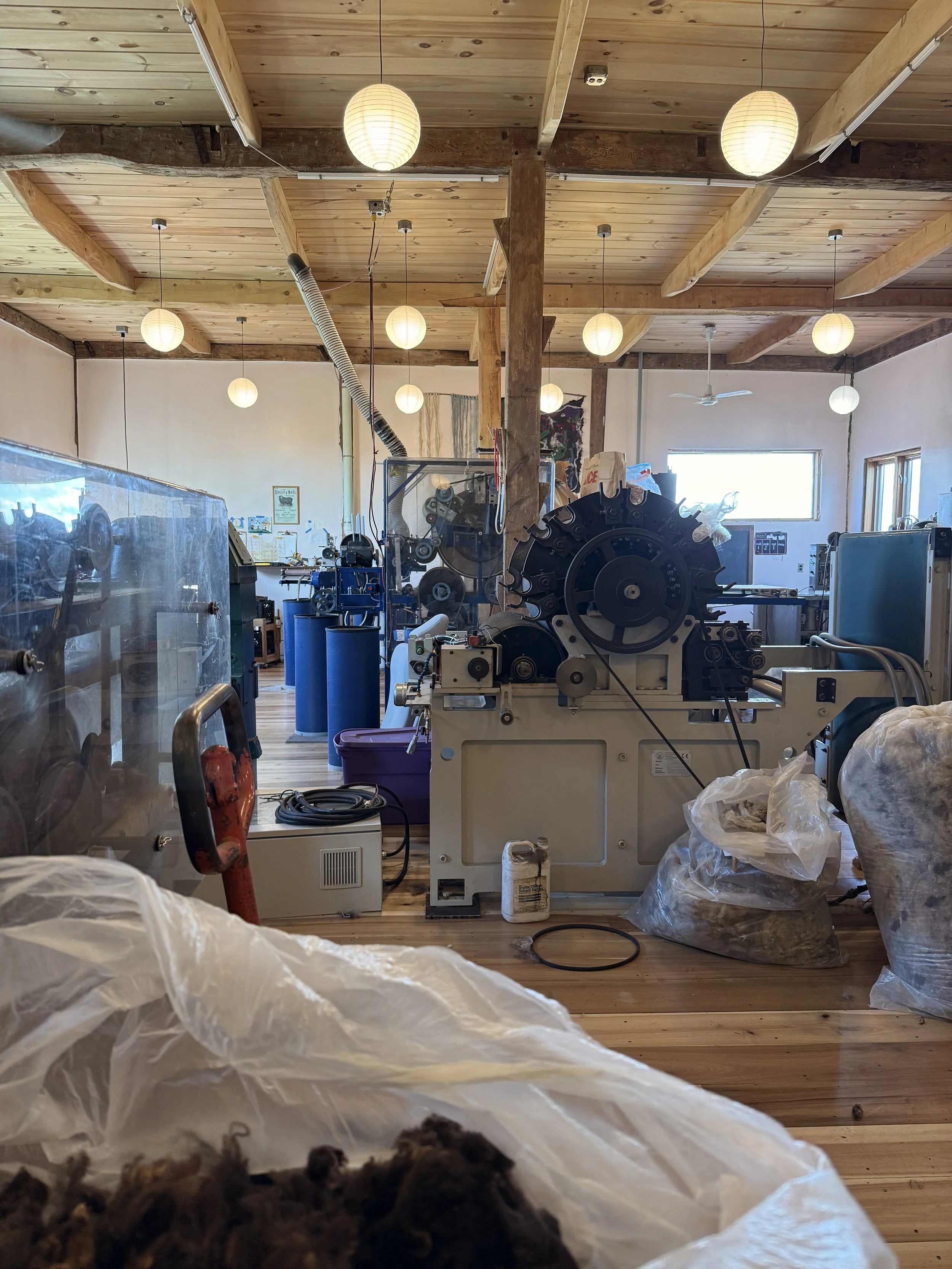
Taken from inside Aurora’s fiber mill on Dodge Farm.
Keeping wool close to home
Much of the clothing we encounter today has traveled through a supply chain that is difficult to see. A fiber may be grown in one country, cleaned in another, spun somewhere else, turned into fabric elsewhere again, and finally cut and sewn far from the person who will wear it.
The efficiency of that system has made clothing abundant and inexpensive. It has also made it harder to understand where our clothing comes from, who made it, and what its price truly represents.
At Aurora, we are working at a different scale. We want to be the chosen processing mill for small and medium-sized shepherds and fiber producers across the Northeast. Their wool comes to us in Central Vermont. It is processed here with care and returned to the farm – or incorporated into something we make. It does not have to move anonymously through a long chain of facilities before it becomes useful again.
This proximity is practical, not symbolic. Regional mills provide working infrastructure for farms. They give shepherds a way to turn fleece into a viable agricultural product. They preserve knowledge, machinery, and skilled work that would otherwise disappear.
They also allow the qualities of a particular wool to remain connected to the animals and landscape that produced it.
We find something fitting in wearing wool grown by sheep that live in the same northern climate we do. Their fleeces protect them through cold winters, and the ups and downs of our other three seasons. Minimally processed, that wool continues to insulate, breathe, and respond to changing conditions when it becomes something we wear.
What the price holds
Working this way also clearly affects the price of a garment.
Small-scale farming and regional fiber processing involve a great deal of skilled labor. Sheep must be raised and tended. Fleeces are sheared, sorted, washed, carded, and transformed. Equipment must be maintained. Each small batch requires attention, and many hands contribute before a finished piece leaves the farm.
Our prices reflect those realities. They reflect wool purchased from regional farmers at rates intended to support their work. They reflect the people working inside our mill and the cost of maintaining specialized machinery. They reflect the time required to create something thoughtfully, in smaller quantities, here in Central Vermont.
This is a different proposition from clothing designed to be inexpensive enough to replace without much consideration. Aurora woolens are made to be worn often and kept for years. Their value is not meant to exist only at the moment of purchase. It grows through use.
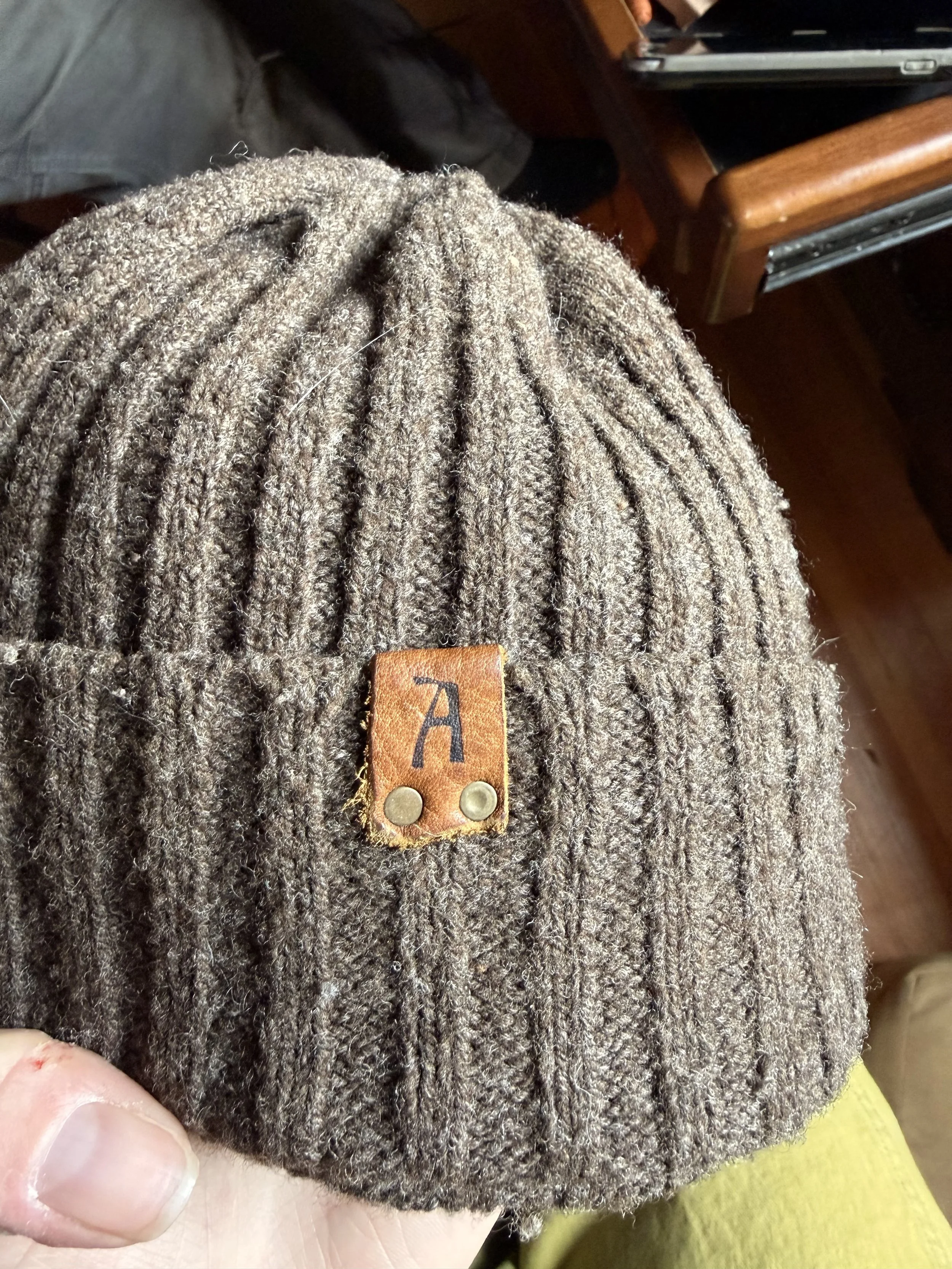
An Aurora made hat, most components lovingly and painstakingly handmade.
Learning to care for wool, again
Minimally processed wool does ask for something in return: a little care.
For generations, caring for wool was ordinary household knowledge. People understood how to air a garment, spot-clean it, wash it gently, reshape it, mend it, and store it well. Many of us have lost confidence in those skills – not because they are difficult, but because modern clothing has taught us that everything should be cared for in exactly the same way.
It does not have to be. Wool is naturally resistant to odors and often needs less washing than we assume. A sweater or vest may simply need to be aired between wears. A small mark can often be spot-cleaned rather than sending the whole garment through a wash cycle.
When a fuller wash is necessary, the process is simple:
Hand-wash the piece, or use a delicate or hand-wash cycle if its care instructions allow.
Use cool water and a small amount of mild detergent made for wool.
Avoid heat and unnecessary agitation.
Reshape the garment while it is damp.
Lay it flat to dry, away from direct heat.
These small acts are not a burden so much as a rhythm. They ask us to slow down briefly and pay attention to a material that was grown, not manufactured into existence.
Convenience is not the only value
Superwash wool has a place. So does minimally processed wool.
One offers ease for garments and lives that require it. The other preserves more of the fiber’s original character and allows wool to move through a smaller, more regional system.
The distinction matters because convenience is not the only quality we can ask of what we wear. We can also value origin, skilled work, agricultural viability, repairability, material integrity, and the possibility that a garment might remain useful for decades.
At Aurora, our choice is to work with wool in a minimally processed state and to help others feel confident living with it that way.
We see ourselves as processors and makers, but also as a resource: for farmers looking for a thoughtful place to bring their fleece, for people curious about how wool becomes cloth, and for anyone learning how to care for natural fibers again.
A good wool garment does not need very much from us. A little air. A gentle wash now and then. The occasional repair. In return, it can offer warmth and usefulness for many years – perhaps long enough to be handed to another person, carrying its place and story with it.
—
SOURCES - thank you to the many thoughtful people and organizations in the natural fiber and knitting world who have written on this topic; some that were useful to us and are good further reading:
The Mindful Designers’ Almanac by Mairin Wilson, the creative force behind sustainable clothing brand Mairin
Shifting the Cost: Why our Clothes are so Cheap by PlanetAid
The truth about superwash yarn on Knit Together by Anne Vally